Build a tech transfer process that doesn’t rely on luck
We know that sometimes tech transfer can feel like a gamble… and in many organizations, it is. Here’s how we turn what can be a risky handoff into a structured, repeatable business process with Digital Tech Transfer.


The cure for the common tech transfer
Deliver measurable results like these across operational efficiency, collaboration, and knowledge.
80%
reduction in labor costs for site-to-site transfers
50%
reduction in time to perform gap assessments
$600K
annual cost savings at a single manufacturing site
Today’s tech transfers can be slow, costly, and unpredictable. We don’t think they have to be
Taking 12–24 months to execute a commercial tech transfer is still the norm. We think it should be 6 months.
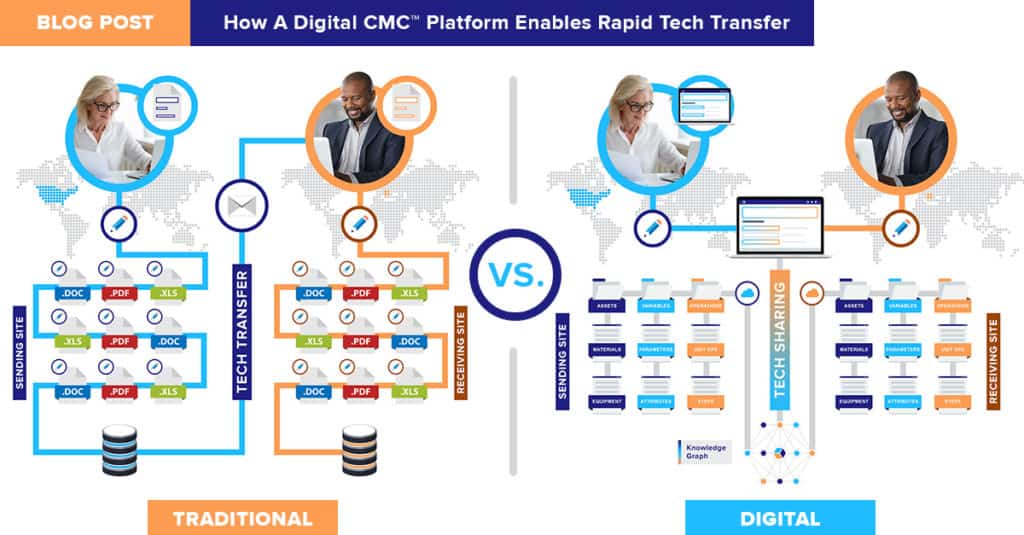
Some organizations still rely on Word documents, spreadsheets, and manual interpretation to move products between sites and partners. At the same time, timelines are shrinking, products often span multiple sites and partners, and regulators expect demonstrable process understanding.
Missed context, misinterpreted specs, and incomplete process understanding surface much, much too late. During engineering runs, PPQ, or worse, commercial execution. What should be a controlled handoff becomes months of rework, unexpected deviations, delayed launches, and avoidable regulatory scrutiny.
Why this matters
Knowledge handoffs are broken
Critical transfer context is lost as documents move between teams.
Gaps are discovered too late
Knowledge gaps surface during execution, not before decisions are made.
Timelines extend
Fixes happen after risk has materialized.
We turn tech transfer from a document scavenger hunt into a single, reliable workflow
QbDVision replaces giant transfer binders and scattered files with a living digital model of your product, process, and methods that stays current the entire time you’re transferring. Instead of emailing versions back and forth and wondering what changed, everyone works from the same environment, seeing the exact intent, risks, and controls in real time.
Receiving teams don’t have to reverse-engineer your process or guess what matters. They can see what’s different, what’s risky, and what needs attention before execution starts. The result is fewer surprises, less rework, and transfers that move in months instead of years.
With Digital Tech Transfer, everyone moves faster
Make sharing knowledge as simple as logging in
Bring development, manufacturing, quality, and CDMO partners together around a single, shared view of transfer requirements and readiness.
Identify gaps and risks instantly
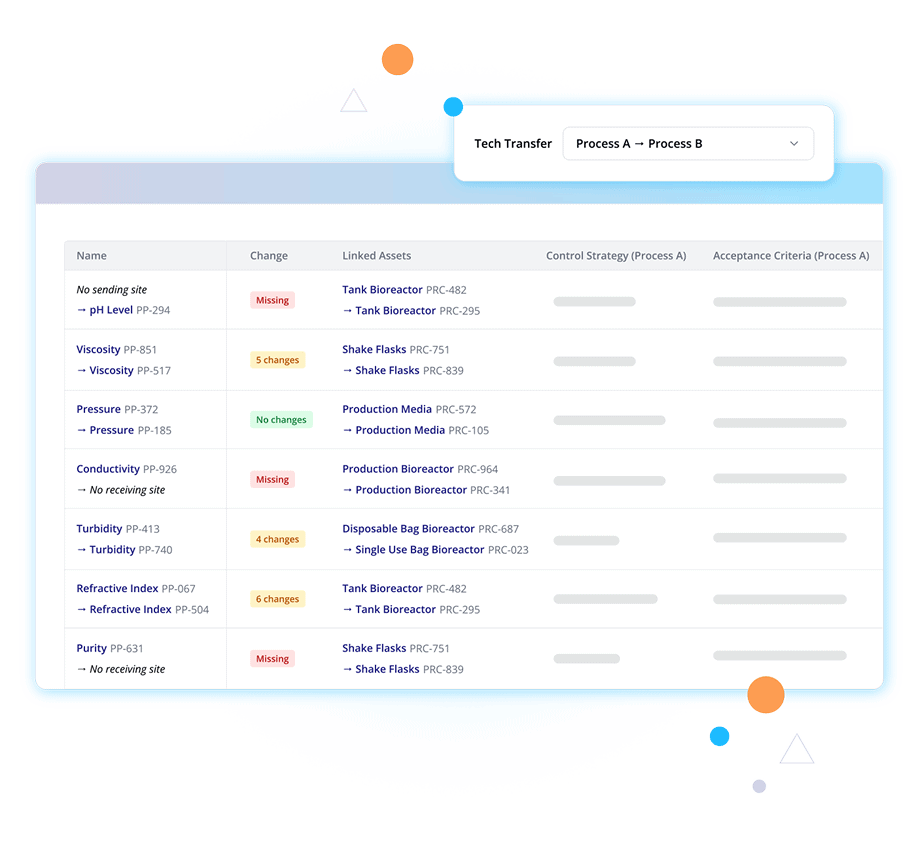
Assess readiness early before execution begins. Align with industry definitions, while digitally comparing sending and receiving unit processes, equipment, materials, and analytical methods.
Refine processes with confidence
Continuously refine methods, parameters, and control strategies as development progresses, with full traceability.
Share knowledge without friction
Bring development, manufacturing, quality, and external partners into one shared digital workspace.
End-to-end sponsor oversight
Maintain product intent, assess readiness earlier, and collaborate more effectively across internal sites and external manufacturing partners.
Align sponsors, sites, and partners from day one
QbDVision connects sponsor analytical teams, internal labs, and CDMOs in one shared digital environment, eliminating ambiguity and misinterpretation.
See risks before they impact timelines
Digitally compare sponsor defined processes and requirements against receiving site or CDMO capabilities across equipment, materials, parameters, and analytical methods.
Maintain control as programs scale and evolve
Refine processes, methods, and control strategies throughout development and scale up with full traceability.
Clear requirements, predictable execution for CDMOs
Gain structured visibility into sponsor requirements, identify gaps sooner, and execute transfers with greater confidence and efficiency.
Receive clearer requirements and collaborate with confidence
QbDVision gives CDMOs direct visibility into sponsor product and process knowledge within a shared digital workspace.
Understand gaps early and plan proactively
Evaluate readiness as soon as a transfer begins. Digitally compare sponsor provided process definitions with CDMO equipment, materials, and analytical capabilities to automatically surface gaps and risks.
Execute efficiently while accommodating change
Continuously refine process steps, methods, and control strategies as programs progress, with full traceability to sponsor intent.
Creating a single source of truth is just the beginning
Whether sending or receiving, successful tech transfer depends on keeping everyone on the same page.
Our Digital CMC platform provides a secure, centralized system of record for product, process, analytical, and risk knowledge. Teams can assess changes, contextualize risks, and track readiness across the full six-stage tech transfer lifecycle, all without rebuilding information from documents.
With QbDVision, tech transfer isn’t a one-time event. It’s a continuous layer of your Digital CMC operating model.
Share knowledge, not just documents
A single source of truth
Get everyone on the same (digital) page with a truly collaborative operating model.
Lifecycle data management
Maintain traceability between product, process, and analytical knowledge from development through commercial manufacturing.
Increase productivity
Eliminate rework, reduce delays, and free experts from document administration so they can focus on science and execution.
“It’s proof of the power of putting structure first. From the very first walkthrough, the client could see that we were ready to start work: we weren’t just presenting a plan, we were ready to execute it. QbDVision makes tech transfers feel less like a handoff and more like a hand-in-glove fit.”
Dive deeper with our CMC thought leaders
MORE INSIGHTS
Take a deep-dive with QbDVision Co-Founder & CEO, Yash Sabharwal.
MORE INSIGHTS
See how Bayer digitized a complex tech transfer with QbDVision, accelerating timelines, improving collaboration, and ensuring regulatory confidence.
See what Digital Tech Transfer looks like in practice
Talk to our Digital CMC experts today.