QbD is more than just DOE...a lot more
As I talk to people about managing process development activities under a Quality-by-Design framework (QbD), I often see this equivalence in the minds of people that Quality-by-Design (QbD) is the same thing as Design of Experiments (DOE). I hear comments such as "Oh, we do QbD using JMP or Statistica." The implication is that the performance of design of experiments using statistical software packages to evaluate critical variables is sufficient to fulfill the requirements of QbD. However, QbD as it is applied to pharmaceutical development has a broader, more holistic definition. QbD is defined in ICH Q8(R2) as a systematic approach to product development that begins with predefined objectives and emphasizes product and process understanding and process control, based on sound science and quality risk management.
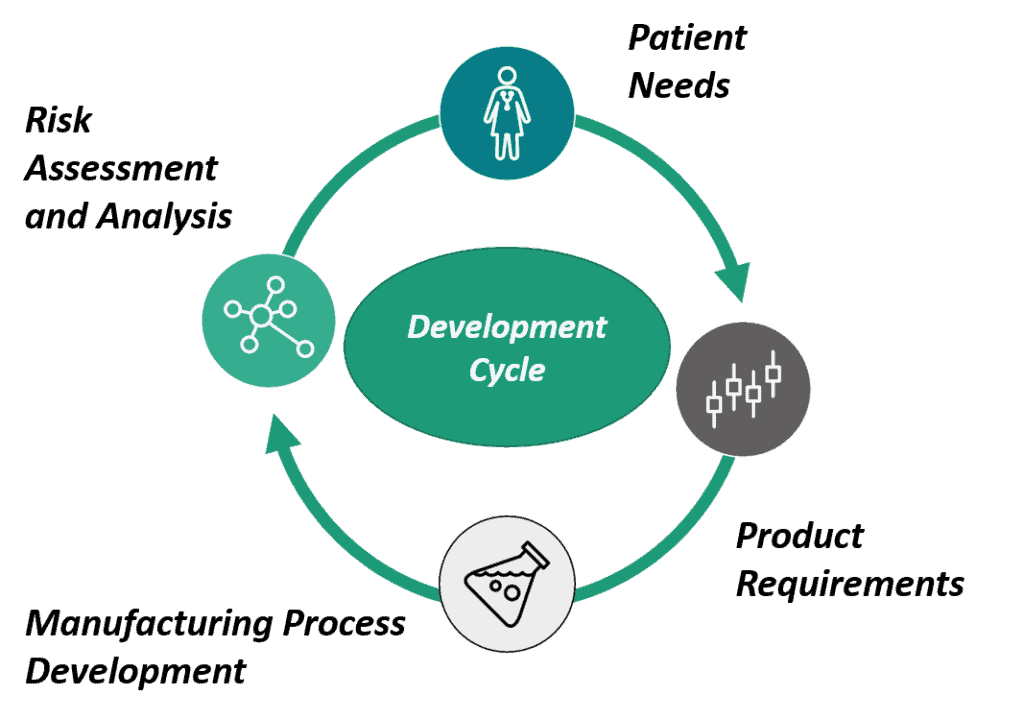
The systematic aspect of QbD creates a framework where patients requirements inform product requirements which then inform process requirements. The patient requirements are recorded as a Target Product Profile and the product requirements are recorded as a Quality Target Product Profile. The manufacturing process is broken out between raw material inputs and unit operations which describe the steps of the manufacturing process. As this process is detailed in full, the number of variables in the form of quality attributes, material attributes, and process parameters grows substantially. Many times, the number of variables is so large that they cannot all be tested. This is where risk assessment comes into the process to help narrow the analysis to those variables where the risks to the product or patient could be significant.
When evaluating the various unit operations, it is often the case that multiple input variables can affect one or two output variables and it is necessary to understand if the variables are independent or if they interact to affect the outputs. This is where DOE comes into the picture providing an approach to efficiently test for variable interaction as well as to estimate the values of the input variables that optimize the outputs. So, the DOE is an element of your QbD strategy but not the only part of it. QbDVision was designed to help you manage your process development as required by ICH Q8 where you can "start with the end in mind" and build process understanding and process control as you execute your development activities.

President, CEO, Co-Founder
Yash Sabharwal
Yash Sabharwal is an accomplished inventor, entrepreneur, and executive specializing in the funding and growth of early-stage technology companies focused on life science applications. He has started 3 companies and successfully exited his last two, bringing a wealth of strategic and tactical experience to the team.