Has eCTD outlived its usefulness?
The Electronic Common Technical Document or eCTD is a specification and interface developed by the International Conference on Harmonization to streamline the transfer of information from pharmaceutical companies to regulatory agencies. The figure below shows how the eCTD is structured into sections of information.
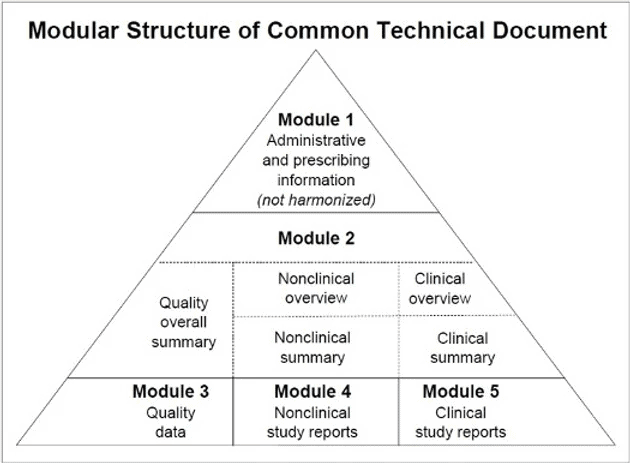
The diagram shows how the information in the eCTD is organized and assembled into categories such as quality, nonclinical and clinical, etc. However, the data in the eCTD does not match the flow of process development and iterative risk assessments which is desired for more efficient review. The eCTD format provides large amounts of unstructured text in PDF format which leads to lengthy and redundant reviews because the key information is buried in the documents. The FDA is now considering moving to a different approach as discussed in this article. Instead of eCTD, the FDA is looking to move to KASA which stands for Knowledge-aided Assessment and Structured Application. The article lists multiple benefits to this approach:
- Improvement of consistency, transparency, communication and objectivity of regulatory actions;
- Allowing assessors to automatically retrieve historical data and information to better inform regulatory evaluation and decision making;
- Facilitate assessment of risk and reduce subjectivity of documentation;
- Reduce time burden for regulatory assessments;
- Allow detection of outliers in control strategy and risk attributes compared to the broader KASA database for improving quality and efficacy;
The last benefit is interesting because it implies that the FDA is looking for opportunities to identify best practices in product and process development and use these as a reference when evaluating similar submissions.
For pharmaceutical companies developing generic or new products, the ability to gather and manage process development information in one place is very challenging. QbDVision was developed to overcome this challenge and provide a data repository where product development information can be recorded in a structured way following the trajectory of process development and risk assessment. Companies using this software solution can assemble their eCTD applications now with this approach in mind and they will be well positioned to dovetail into the KASA submission process when it is implemented in the future.

President, CEO, Co-Founder
Yash Sabharwal
Yash Sabharwal is an accomplished inventor, entrepreneur, and executive specializing in the funding and growth of early-stage technology companies focused on life science applications. He has started 3 companies and successfully exited his last two, bringing a wealth of strategic and tactical experience to the team.