Why Knowledge Management and QbD Principles Are Key to Drug Development’s New Supply Chain Era
Like so many sectors of the biopharma industry, the COVID-19 pandemic was a rude awakening for the drug development supply chain.
Seemingly overnight, the world became hyper-aware of how raw materials flow to and through our labs and facilities… and just how rigid that flow can be. At the same time, drug developers found themselves scrambling to accelerate a new generation of Advanced Therapy Medicinal Products (ATMPs) – only to find that supply chain challenges were especially acute for innovative drug products that demand a host of unique components.
Ever since, the search has been on for more flexible and resilient ways to manage the life sciences’ ever-evolving universe of raw materials. Today, we’re finally starting to see the start of a new era in the drug development supply chain, one with huge potential to remove long-standing roadblocks and accelerate new therapeutic advances.
But to unlock the full potential of that era, we need to address one big, as-yet-unanswered question: how do we handle all those arcane new ingredients?
Legacy registration methods have hit their limits
In many ways, today’s drug development landscape is a scientific wonderland full of innovative cell-and gene-based therapies, personalized treatments, and novel approaches to repurposing existing therapies.
At the same time, this new generation of biologic wizardry is increasingly reliant on mugglish material registration practices for their innovative components – ones that are by definition non-compendial. In the age of custom mRNA, this simply doesn’t cut it.
But you might be thinking, “Well, why not?” Well let’s have a look at the current state of raw material registration.
In this new supply chain era, there’s huge potential to remove long-standing roadblocks and accelerate new therapeutic advances. But one unanswered question stands in the way: how do we manage this new generation of innovative raw materials?
Today, raw material controls are most often defined by the license holder, who typically demonstrates control by registering the dedicated Raw Material Supplier and Part ID. The flaws in this approach become painfully obvious as soon as that material needs to be replaced or substituted:
Difficult substitution process
When registration comes down to a vendor’s Part ID, sourcing alternative materials can be a daunting, disruptive process – one that requires expensive, time-consuming re-validation and regulatory notification steps once the “new” material is introduced.
Lack of meaningful attributes
Even more importantly, this outdated form of registration is based on supplier-defined specifications, not an understanding of the critical material attributes (CMAs) that actually influence final product quality.
CMC programs have struggled with these limitations since long before today’s supply chain disruptions and growing demand for trailblazing raw materials. Now, with both these challenges converging, it’s more than time for a new, modern approach to registering raw materials – one that’s grounded in the attributes that actually influence product quality.
The BioPhorum approach: Bringing QbD principles to the table
In a recent whitepaper, BioPhorum’s Regulatory Governance Team proposed an alternative approach to registering innovative raw materials. Much to their credit, it delivers a welcome injection of product & process understanding - key enablers of the Quality by Design methodology.
The crux of their forward-thinking approach: registering today’s innovative class of raw materials via their CMAs. CMAs are any “physical, chemical, biological, or microbiological property or characteristic of an input material that should be within an appropriate limit, range, or distribution to ensure the desired quality of that drug substance, excipient, or in-process material” – making them a valuable way to identify and register new materials using intrinsic traits.
BioPhorum offers a simple, systematic process for identifying CMAs:
STEP 1STEP 2STEP 3STEP 4Define the target material profile (TMP)Describe the material attributesReview the product summary control strategyIdentify the CMAs required to ensure product quality and safety
Those four steps have the potential to take us all a huge step in the right direction. But of course, there’s a catch.
These proposed best practices make a big assumption: that suppliers and sponsors have a readily accessible knowledge base that they can leverage to define their CMAs and assess the subsequent impact on related Critical Quality Attributes (CQAs) and Critical Process Parameters (CPPs). That resource is a fundamental component of QbD methodology – but often one that’s sorely lacking in many documentand SharePoint-dependent CMC programs.
BioPhorum’s solution is definitely a step in the right direction: an Excel-based worksheet for managing qTMP definitions and linking them to CQAs. But as much as we’re thrilled to see key QbD principles at work, we’d hate to see any new approach add one more XLS drop to CMC’s spreadsheet ocean.
In fact, BioPhorum’s own URS for Knowledge Management Systems in Biopharmaceutical Manufacturing makes a much-needed push for stronger data structures and modernized knowledge management in the drug development process. So we’ll make a bold ask: Isn’t there a better way to create the knowledge and data structures we need to bring QbD principles to raw material registration?
Modern knowledge management: Taking the BioPhorum method a step further
Knowledge Management is by no means a new concept in the life sciences industry – but it often feels revolutionary when so many organizations, across the industry, still use SharePoint as a corporate data landfill.
At QbDVision, we think it’s high time drug developers had a good recycling plan.
A technological wave is already hitting the shores of drug development. Regulatory agencies are discussing a move to a cloud-based submission process. Ever-growing volumes of information and data are being generated across the drug development life cycle. Stop to take a breath, and one thing is clear: it’s more important than ever for pharma and biotech companies to consider how they store, structure, and attempt to leverage their knowledge. Especially if they plan to stay competitive in today’s increasingly data-driven industry.
For far too many CMC programs, SharePoint still serves as an organizational data landfill. At QbDVision, we think it’s time for a good recycling program.
Applied to life science businesses, knowledge management is nothing more than a systematic approach to acquiring, analyzing, storing, and disseminating information related to products, manufacturing processes, and components. Implementing that kind of system turns data into a usable resource and knowledge into a universal asset. And most importantly for the supply chain, it can turn specific CMAs into the secret to flexible, robust material registration.
Let’s have a closer look at how.
There’s a reason it’s called data “governance”
When we talk knowledge management with our customers, partners, and prospects, there are a few first principles we always start with. Number 1: Effective knowledge management has to start at the top.
Employee buy-in is essential, of course, especially when it comes to the long-term success of any strategic initiative (or individual solution, for that matter). But transformational, company-wide change takes investment, guidance, and (yep, sometimes) enforcement by senior leadership.
That’s the key to any kind of "governance": the policies, procedures, and structures that regulate how an organization runs, and how it maintains both organizational and individual accountability. Governance frameworks help managers ensure that their teams have the support, guidance, and incentive to pursue business goals and follow best practices – especially when it comes to capturing, organizing, and sharing knowledge.
But while many organizations know that knowledge management is a priority, many still fail to put that conviction into practice. In fact, Deloitte reports that 75% of surveyed organizations see creating and preserving an institutional knowledge base as significantly important to their overall success over the next 12-18 months – yet only 9% of organizations are confident that they’re ready to deliver on that effort.
Sobering stuff when those organizations are in just about any industry domain – but tragic when “overall success” is measured in output of potentially life-saving therapies.
So where can drug developers, manufacturers, and suppliers start implementing the knowledge management strategies they need to prepare for this new generation of raw materials?
Rule #1: Start with the siloes.
Breaking down barriers to holistic knowledge management
See if this sounds familiar: Your formulators and process development scientists, regulatory affairs group, and supply chain team are all fountains of valuable knowledge for your organization. One uses Google Drive, one uses SharePoint, and the other just keeps everything in Teams.
We’ll let you take another deep breath before we talk about the different naming conventions and file structures each team uses.
Without a governing framework or structural model, most CMC programs default to “knowledge management” practices that are heterogenous at best – and all too often decided ad hoc by the various teams that use them. Convenient? Yes. Expedient? Sure. But very soon these “methods” can become a major obstacle to collaboration, problem-solving, effective resource allocation, and more.
All too often, CMC “knowledge management” happens ad hoc within separate teams and silos. It’s time for a smarter way to centralize, structure, and share the critical data each team generates.
But what if it didn’t have to be that way? What if there were a way for CMC teams to find all the information they need in one continually updated source – CMAs and CQAs very much included – without navigating information silos and gatekeepers?
To break free of legacy material registration methods, that’s the future we need to aim for. And it’s very much here already – when your development program has the right tools.
How CMC programs can start unlocking the power of their knowledge
While data may be the new oil, it remains an untapped resource for many pharma and biotech companies. But not only cultural barriers stand in the way.
Today, drug developers’ vast lakes of data are largely unstructured – and thus largely unusable. Much of it may have internal structure – in spreadsheets, presentations, and emails – but without predefined data models, it’s incredibly difficult to extract and analyze the raw data contained in these resources.
So how can we begin to structure critical information like CMAs, and tap their potential to transform raw material sourcing and registration?
Start with the basics: CMAs are simply material characteristics that can influence product quality, safety, and efficacy. These characteristics can form the foundation of a data structure, one with a hierarchy of criticality and linked to related dependencies, parameters, risk factors, and more.
Once you add all those dimensions to the foundational characteristics, you’ve essentially created an ontology for your CMAs – one that’s based on domain-relevant taxonomies, and that can be probed on any of the dimensions you’ve built on the original attributes.
CMAs are simply material characteristics that can influence product quality, safety, and efficacy. Characteristics like these are an ideal foundation for domain-relevant taxonomies and data structures.
This kind of structured data framework has immense potential for all of CMC’s many attributes, parameters, requirements, and more. ICH requirements to determine the functional relationships between material attributes, process parameters, and CQAs? Simplified and visualized. Full contextualized risk assessments? Mitigation strategies will be clearer than ever.
All it takes is the right framework for your CMC data. And that’s where we come in.
QbDVision: Reimagining raw material registration with every click
So what’s the best way to capture CMC knowledge in a structure that unlocks its value? Manage it in a unified, structured platform – one that’s purpose-built to modernize the way you organize your product, process, and materials data. One tool, and you’re already on your way to a smarter, more flexible way to register new raw materials.
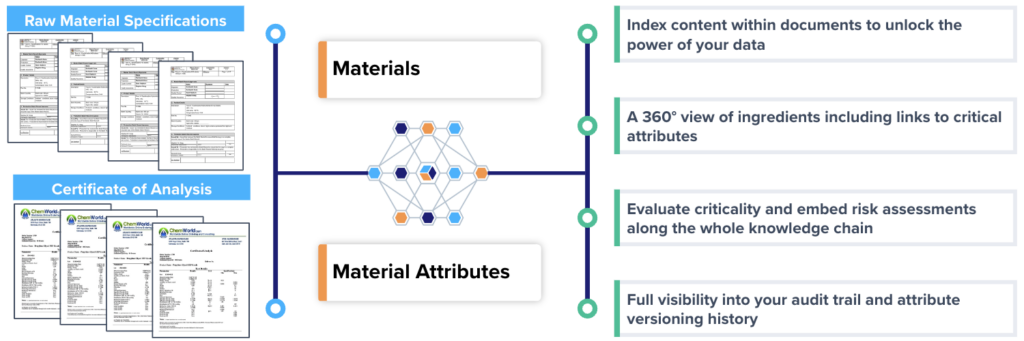
Let’s take a look at two key material-related records in QbDVision: the material itself and then the associated material attributes.
Materials
Within this one record, you’ll find a complete dossier of information for any given material:
- General description
- Intended use
- Links to associated processes
- Quantity
- Qualification
- Regulatory status
- Chemical properties
- Tech transfer considerations
One view gives you a 360-degree look at that ingredient, including links to each critical attribute that can influence product quality, safety, and efficacy.
Material attributes
This related record similarly provides a comprehensive view of each material attribute – starting with a general description, then enhanced with links to related unit operations, process steps, and equipment that that material will interact with during development or production.
In this contextualized structure, it takes just a few clicks to evaluate criticality, and potentially turn an MA into a CMA. It’s also easy to embed risk assessments at key points along the whole knowledge chain, using linked acceptance criteria, control methods, process capabilities, and risk controls. Bonus: Full visibility into your audit trail and attribute versioning history.
Ask yourself: how many of your teams are typically involved in consolidating, populating, and applying this information? How long would it take to gather, organize, and sift a mountain of scattered documents from multiple departmental silos?
With QbDVision: Log in, look up two linked records, and see exactly how every raw material fits into your processes.
And that’s just the beginning. Imagine how much more efficient, productive, and collaborative your teams could be when every resource, attribute, and parameter in your development program is available to them in the exact same contextualized, insight-rich format.
We’d love to show you exactly what it looks like!
Beyond CMAs: Structuring your entire CMC knowledge base
Records like these are more than just a structured, centralized source for key development data. They’re representative units of something much greater: a logical, holistic, framework for your entire CMC program, complete with the kind of standardized taxonomy that’s essential to a true organizational knowledge base.
In QbDVision, that structure extends far beyond Materials and Material Attributes. In fact, it can cover every attribute, parameter, unit operation, step, and equipment in your program. With our platform’s linking structures, you can see and analyze all that data in unprecedented ways – including novel, data-enriched visualizations that show you the impact of changes, variances, and nonconformities at a glance.
So what does that mean for the future of raw material registration? BioPhorum’s new method shows promise, but another important step needs to happen first: drug developers need to stop indexing documents and start indexing the data in those documents, starting with all the documents where CMAs, CPPs, and CQAs are hiding today.
By rethinking the way those assets are structured, linked, and integrated, we can change the way we register all those innovative raw materials – and then we might be able to transform the whole supply chain they flow through.

Director, Account Management
Lewis Shipp
Lewis previously held roles as a CMC Writing Consultant, Teaching Assistant in Pharmaceutics and Pharmacovigilance Associate, as well as engaging in research activities concerned with the use of 3D printing technologies for drug delivery applications. He is published in the Journal of Controlled Release.