
Building Scalable AI for CMC
Applying AI in Regulated Environments
AI continues to make its way into pharma workflows, with models like AlphaFold and Gemma driving significant advances in discovery and development. But when it comes to Chemistry, Manufacturing, and Controls (CMC), the conversation is different. The challenge isn't just building AI, it's building AI that scales in regulated environments. In CMC, scalability means the ability to deliver trustworthy, repeatable outcomes across growing volumes of development and manufacturing data, multiple products and processes, global teams, and evolving knowledge while maintaining governance, traceability, compliance, and confidence in every output.
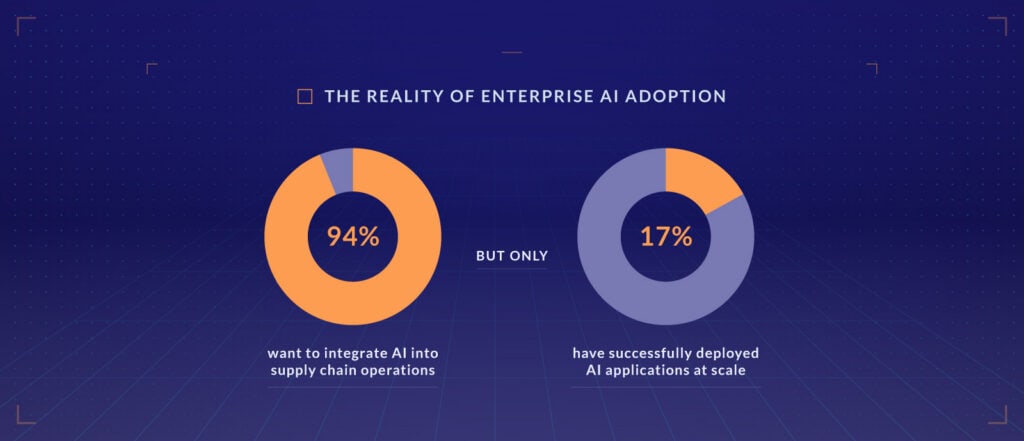
The challenge of scaling AI is not unique to pharma. Across industries, organizations are investing heavily in AI, yet relatively few have successfully deployed it at scale. According to industry research, 94% of organizations want to integrate AI into their operations, but only 17% report successfully deploying AI applications at scale. This gap highlights a common reality: buying an AI model is relatively easy; creating the data foundation, governance framework, and operational processes required to deliver consistent, trustworthy outcomes across an organization is far more difficult. In regulated CMC environments, where every decision must be traceable, explainable, and compliant, that challenge becomes even more significant.
To build AI that can scale in these regulated environments, we need two things: a structured data foundation, and a domain-relevant framework that enables trustworthy model outputs.
Think of it like you’re building, well, a building. Without a solid foundation, everything above it will fall apart. But you also need to design and construct it to serve the long term purpose. If you’re trying to build a house and you end up with a museum, it might be fun for a night or two, but living in it forever would be tricky.
The same goes for AI in CMC. It needs a solid foundation built on structured data and a framework that enables scalability, both things that we here at QbDVision certainly know a thing or two about. Because while AI can read documents, it cannot magically resolve the challenges of fragmented, inconsistent, and context-poor information. In regulated environments, trust depends not only on what answer the AI provides, but on its ability to trace that answer back to the underlying product and process knowledge. Without that foundation, AI may be intelligent, but it cannot be reliably trusted at scale.
At QbDVision, we are creating a blueprint for AI that is scalable, governable, sustainable, and credible for use in CMC. But before we get into the specifics, let's cover the basics.
Why Basic LLMs Fall Short in CMC
General-purpose LLMs are good at a lot of things. They can summarize text, find patterns, quickly scan large documents, generate insights, and if this ChatGPT ad is accurate, help some teens fix up an old truck. They have a broad general knowledge base, but they’re not built for the scientific rigor of CMC.
They’re not even measured for it. Of the many benchmarks that are used to measure the performance of models like Claude Sonnet 4.6 and ChatGPT 4, not a single one of them is CMC-specific. And that’s fair; most Claude users probably aren’t asking: “What receiving site differences pose the highest risk to our established CQAs?” But these general benchmarks fall short when it comes to CMC for several reasons:
- Lack of context: Standard benchmarks like the ones in Stanford’s Foundation Model Transparency Index are able to identify general gaps, but fail to account for the specific nomenclature and process logic of drug development and commercialization.
- Semantic misalignment: A LLM might identify a duration value but mislabel a "Storage Duration" as an "Operating Duration" because it relies on text proximity instead of pharmaceutical process logic.
- Tight tolerance: In technical fields, a single character difference, such as "kg" vs. "mg”, can break dependent systems. LLMs attempt to normalize spellings, which leads to deviation from the source data.
- Hallucination: When a source document is silent on a specific parameter, LLMs will invent values. Benchmarks fail to detect this type of error because they assume that an answer exists.
These generic benchmarks are not enterprise-ready; for AI that can perform in real-world scientific settings, we must measure it against real-world scientific expectations. And while there’s been progress with AI benchmarks on the research front, they’re still lacking in the CMC domain.
Basic document search using retrieval-augmented generation (RAG) improves accuracy, but remains fundamentally limited. With naïve RAG, documents are stored in a vector database and retrieved based on semantic similarity to a user's query. While this grounds an LLM in those documents, the structure required to generate a trustworthy output is still missing.
So if these models and their accompanying benchmarks don’t measure up when it comes to CMC, what does?
Scalable AI for CMC
QbDVision's Scalable AI is purpose-built for CMC. It utilizes frontier models within a controlled, validated framework, ensuring compliant use in regulated environments. Outputs are trustworthy because they are grounded in approved records and data. And as with all things Digital CMC, a structured data foundation is key.

Scalable AI treats LLM outputs as presentation layers. Its role is to surface information and compile narratives, not to create, store, or define the underlying facts. The structured data model remains the source of truth, while the LLM acts as an interface for accessing and communicating that information.
If we were to rely on an LLM to both generate the narrative and determine the relevance of the facts behind it, outputs would be unpredictable. Such unpredictability introduces operational risk in the form of hallucinations, inconsistencies, and the potential for the same prompt to produce different results over time. By grounding LLM workflows in a structured data model, we ensure that AI outputs are based on trusted, traceable information. The result is AI that is more reliable, consistent, and ready to support regulated environments.
Even within this controlled framework, we operate on a "trust but verify" model. EachAI-generated output is reviewed by humans before being adopted as an approved record. Tracking what content is generated and how it was approved in logs provides the transparency required for regulatory oversight. AI supports workflows and accelerates access to knowledge, but it never replaces validated workflows or approved reports used for decision-making.
The Pillars of Scalability
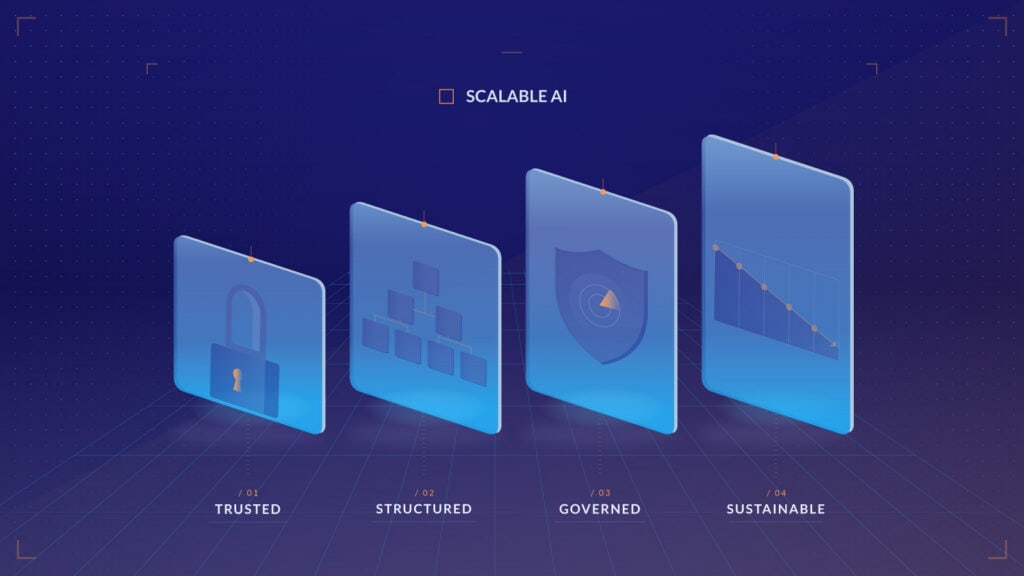
AI can only create enterprise impact in CMC if it’s designed with scalability in mind. The pillars that scalable AI is built on include:
- Trusted: AI can’t scale without a trusted foundation. Secure AWS infrastructure, governed data, traceability, and measurable AI performance create the confidence needed to deploy AI in regulated CMC workflows while maintaining compliance, oversight, and scientific integrity.
- Structured: AI is activated using end-to-end CMC knowledge that lives within our structured, domain-relevant framework. Data is atomized and contextualized within a centralized knowledge base that preserves relationships, context, and version history across products, processes, and regulatory information. This enables AI to access not only the most current knowledge, but also the appropriate version of CMC data, regulatory guidance, and business rules required for a specific use case whether that means an effective process, a submitted filing, an approved future-state process, or organization-specific SOPs.
- Governed: We ensure that every AI interaction is traceable and compliant with enterprise standards through a Model Registry and Change Control Audit process. For each interaction, we record the model version, prompt version, schema version, code version, and other relevant metadata used to generate the result. This information becomes part of a 21 CFR Part 11-compliant audit trail, enabling reproducibility, attribution, and long-term data retention as required by the pharmaceutical industry. Models, schemas, code, and evaluation datasets are versioned and linked, allowing any observed behavior to be traced to the specific configuration that produced it.
- Sustainable: We reduce compute usage by shifting AI from a document-processing model to a knowledge-driven model. In traditional environments, AI must repeatedly search, interpret, and reprocess documents each time a question is asked. By operating on structured, atomized, and connected CMC knowledge, AI can access the information it needs directly rather than recreating context from scratch. This reduces redundant computation, improves consistency, and enables scalable performance at a lower operational cost.
Our Evaluation Framework
Continuous evaluation of LLMs is essential to ensure their credibility and auditability, especially in CMC, and allows users to correct for any drift or regression that may arise. The multi-pass evaluation framework allows us to benchmark performance of LLMs specific to CMC use cases. We use:
- Schema enforcement: We use tools to enforce strict data structures; this ensures that data types are consistent across all data transactions. If a model output does not conform to the schema, it is rejected. This corrects for model deficiencies and delivers consistent results across multiple runs.
- Knowledge graphs: Our records exist in knowledge graphs that define parent-child data relationships (e.g., Unit Operation to Process Step). We do not extract child records until the parent context is known, maintaining relationships between complex record sets that naive models cannot achieve. Execution order is critical to capturing CMC knowledge.
- Record workflows (Human-in-the-Loop): We never use AI for autonomous decision-making. Every AI suggestion is subject to human review. Our audit logs track the original AI suggestion versus the final human-verified entry, providing the transparency required for regulatory audits.
A Digital CMC Foundation Enables AI at Scale
AI has the potential to unlock a whole new world of possibilities in CMC. But in order for it to really have an impact, it needs to be scalable. And in order for it to be scalable, it needs to be built on a solid foundation, and it needs to be built for CMC.
QbDVision has spent years building that foundation with our Digital CMC platform, and we’re excited to be developing scalable AI that will help organizations deliver life-changing therapies to patients faster. Our platform was built on Quality by Design principles, and our AI is no different.

Senior Product Manager
Jack Morel
Jack is a synthesist and former research scientist. As a product manager, they bring together the best parts of software, hardware, and biology to bring therapies to patients faster. In the past they've worked in product management at SaaS and CDMO companies, led solution engineering for F500 biotech and pharma, and developed laboratory automation late stage drug development.